
Signal Processing Algorithms and Spectral Analytics
In real-world RF environments, a signal almost never looks like it does in a laboratory or a simulator. The spectrum is congested, interference is time-variant, channels are unstable, and signals of interest (SOI) are often buried beneath the noise floor. Consequently, signal processing algorithms are not merely auxiliary components; they are the critical elements that determine whether a system can function in the field rather than just on a test bench.
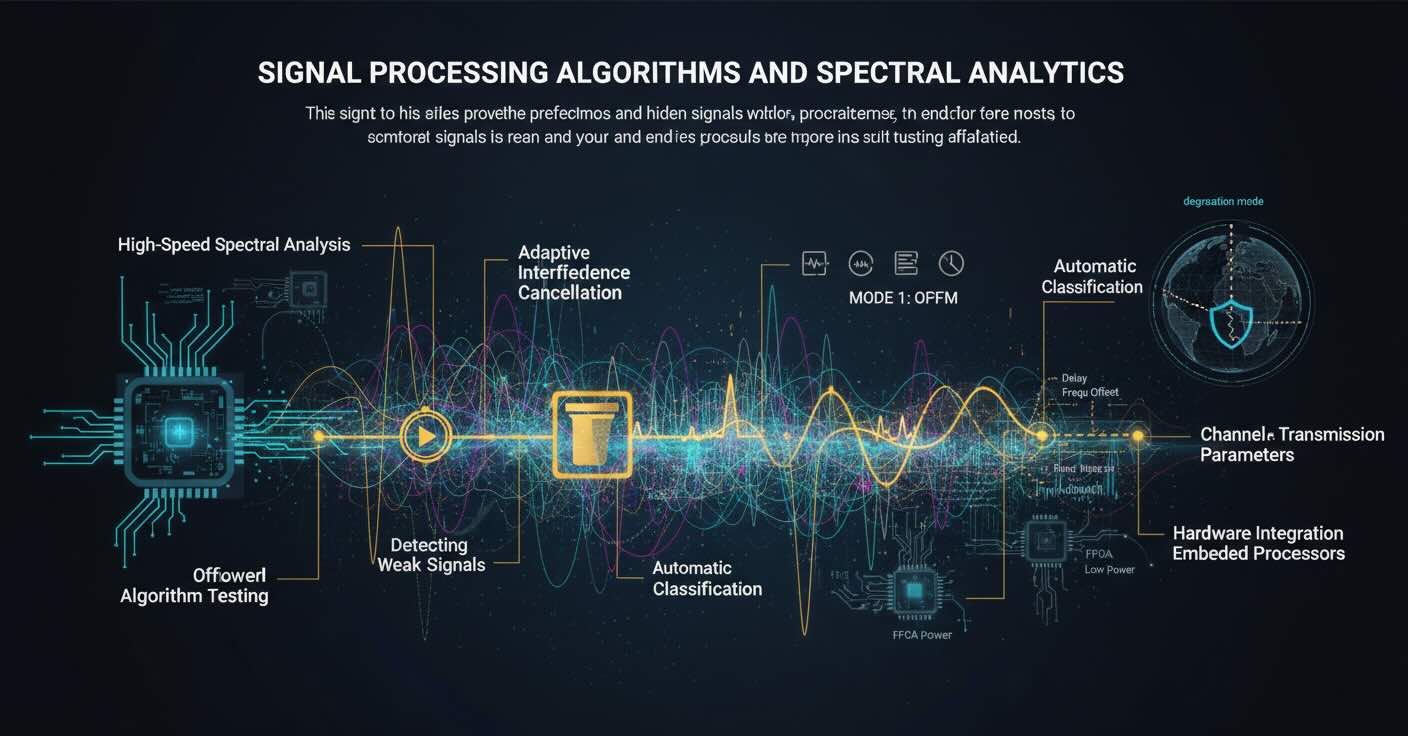
Our work begins with high-speed spectral analysis. Data streams from wideband receivers require real-time processing without sacrificing temporal resolution or accumulating latency. It is not enough to simply “calculate an FFT”; we must build a complete pipeline—from digitization to spectral representations that serve as the foundation for detection, classification, and analytics. Many of these operations are offloaded to hardware logic (FPGA) or optimized for embedded processors to ensure consistent throughput without excessive power consumption.
However, raw spectral data offers little value if the environment is constantly shifting. This necessitates the next level of processing: adaptive interference cancellation. The system continuously evaluates the background noise, identifies recurring patterns, separates random noise from systematic interference sources, and dynamically adjusts filtering and detection thresholds. This ensures that sensitivity to useful signals is maintained even when the overall interference floor rises significantly.
Detecting weak signals in a congested spectrum presents a unique challenge. In such scenarios, classical threshold-based methods perform poorly. We apply combined approaches: energy accumulation over time, correlation methods, spectral stability analysis, and dynamic signal behavior tracking. The goal is not just to log activity, but to distinguish legitimate signals from random noise fluctuations.
Once a signal is detected, the challenge shifts to identification. Automatic classification is based on a combination of spectral, temporal, and statistical features. We analyze bandwidth, modulation structure, fragment repeatability, and temporal behavior. Initial classification is often performed at the edge (peripheral nodes) to reduce data overhead and accelerate system response, while deeper analytics are executed at the server level using accumulated historical data.
In parallel, the system evaluates channel transmission parameters. This goes beyond simple signal levels or Signal-to-Noise Ratio (SNR). We account for multipath effects, propagation delays, frequency offsets, and temporal channel stability. These assessments are used both to adapt reception modes and to select optimal data transmission strategies in communication and monitoring systems.
A crucial point is that these algorithms do not exist in isolation from the hardware platform. Their complexity, precision, and speed are always balanced against the actual resources of the processors, FPGAs, and power systems. Therefore, algorithmic decisions are made in tandem with architectural ones: determining what is more efficient to implement in hardware logic, what belongs in software code, and what should be offloaded to higher-level analytics.
Algorithm testing is conducted using more than just synthetic data. We utilize recordings from real environments and various load scenarios, and we model “degradation modes” where data may be lost or delayed. Algorithms must be resilient not only to noise but also to the imperfections of real-world infrastructure.
From a practical standpoint, high-quality spectral analytics grant a system the ability to not just “see the airwaves,” but to understand the electromagnetic environment and adapt its behavior accordingly. This reduces false positives, enhances service stability, and ensures more efficient use of available frequency resources.
For partners and infrastructure operators, this results in more predictable system performance, reduced reliance on manual tuning, and the ability to scale without a proportional increase in management complexity. The algorithmic core becomes the foundation for the stable, manageable, and economically viable long-term operation of radio-electronic solutions.