
Hardware Module Architecture and Production Readiness
In radio-electronic systems, hardware architecture is more than just a matter of selecting components. It determines how the system behaves under load, the stability of parameters across different units, and whether a prototype can be seamlessly transitioned into mass production.
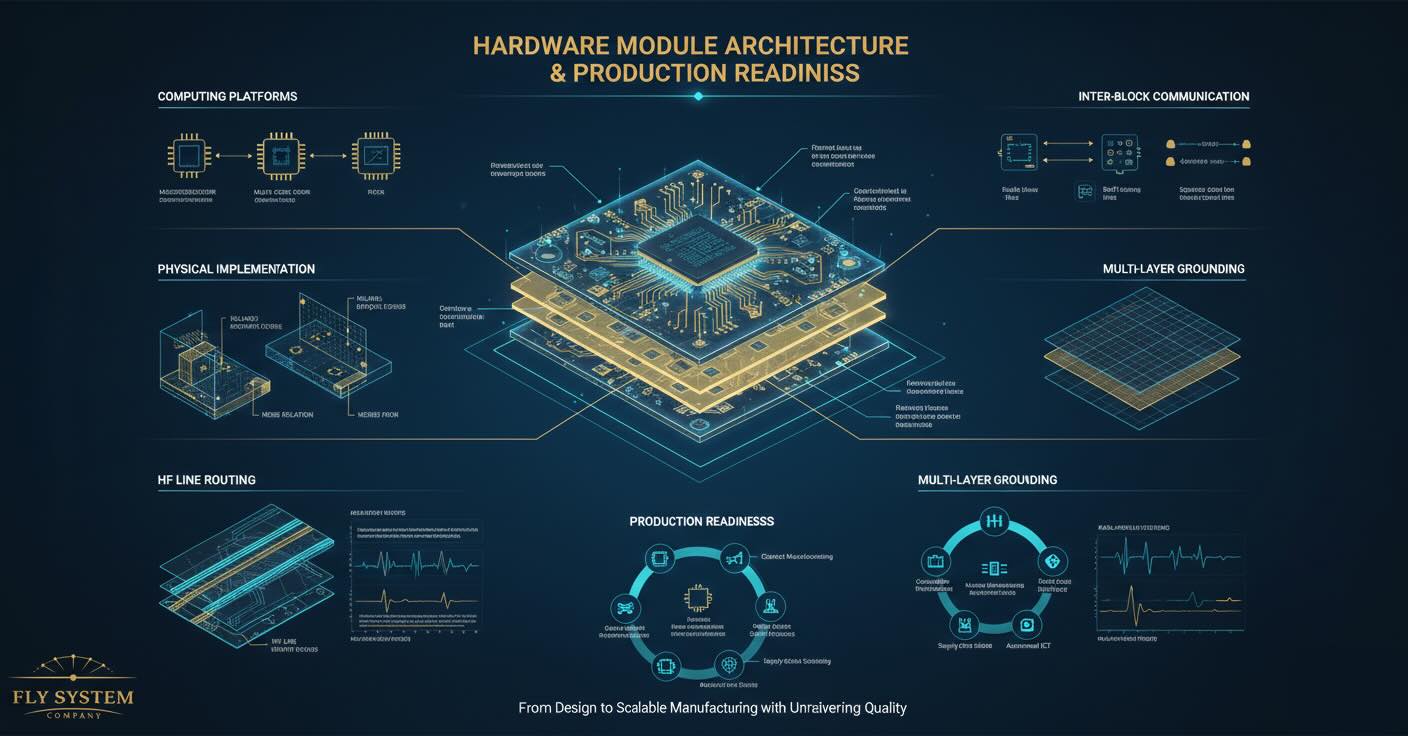
Our work with hardware begins with the selection of computing platforms. There is no universal solution: some applications require microcontrollers with hardware-level real-time support, others demand full-scale processor systems, while high-speed data processing paths necessitate programmable logic (FPGA). Frequently, a hybrid approach proves optimal—distributing tasks between the processor and FPGA with a clear functional split and minimal latency between domains.
The next critical challenge is inter-block communication. The data bus structure determines not only throughput but also system stability during peak loads. We design the architecture to prevent any single interface from becoming a bottleneck, incorporating parallel flows, buffering, and the separation of control and high-speed channels. This ensures scalability without requiring a total PCB redesign.
Even a perfect logical circuit is flawed if the PCB acts as an antenna for its own interference. A significant portion of our engineering effort is dedicated to physical implementation: isolating noise-sensitive zones, separating analog and digital paths, and controlling ground return currents. At this stage, success depends on meticulous routing details rather than high-level diagrams; overlooked details often manifest in mass production as unstable parameters or Electromagnetic Compatibility (EMC) failures.
Multi-layer grounding is utilized as a tool for managing the electromagnetic environment within the board. Properly designed reference planes stabilize line impedance, reduce parasitic emissions, and improve characteristic repeatability in serial units. This is critical for RF paths, where even minor deviations can cause significant variance in device behavior.
We pay specialized attention to high-frequency (HF) line routing. Beyond trace width and impedance control, we focus on differential pair symmetry, layer transitions, and the influence of adjacent signals that might seem unrelated to the RF path. Every detail is verified through simulation and prototyping before the design is finalized as manufacturing documentation.
This engineering precision serves a practical goal: ensuring the board performs identically in the first, hundredth, and thousandth unit. The design is evaluated from the outset for reproducibility in contract manufacturing, accounting for component availability, process tolerances, supply chain stability, and automated in-circuit testing (ICT) capabilities.
Production readiness is not a separate phase following development; it is an integral part of the design process. Test points, automated programming interfaces, and built-in self-test (BIST) mechanisms are embedded during the schematic and layout phases. As a result, manufacturing receives a scalable platform with predictable characteristics and controlled quality, rather than just a PCB file.
This approach enables a transition from prototypes to serial production without painful redesigns or the endless “minor tweaks” that often delay product launches by months. For our partners, it means technical solutions can be planned with a focus on long-term operation and product evolution from day one.