
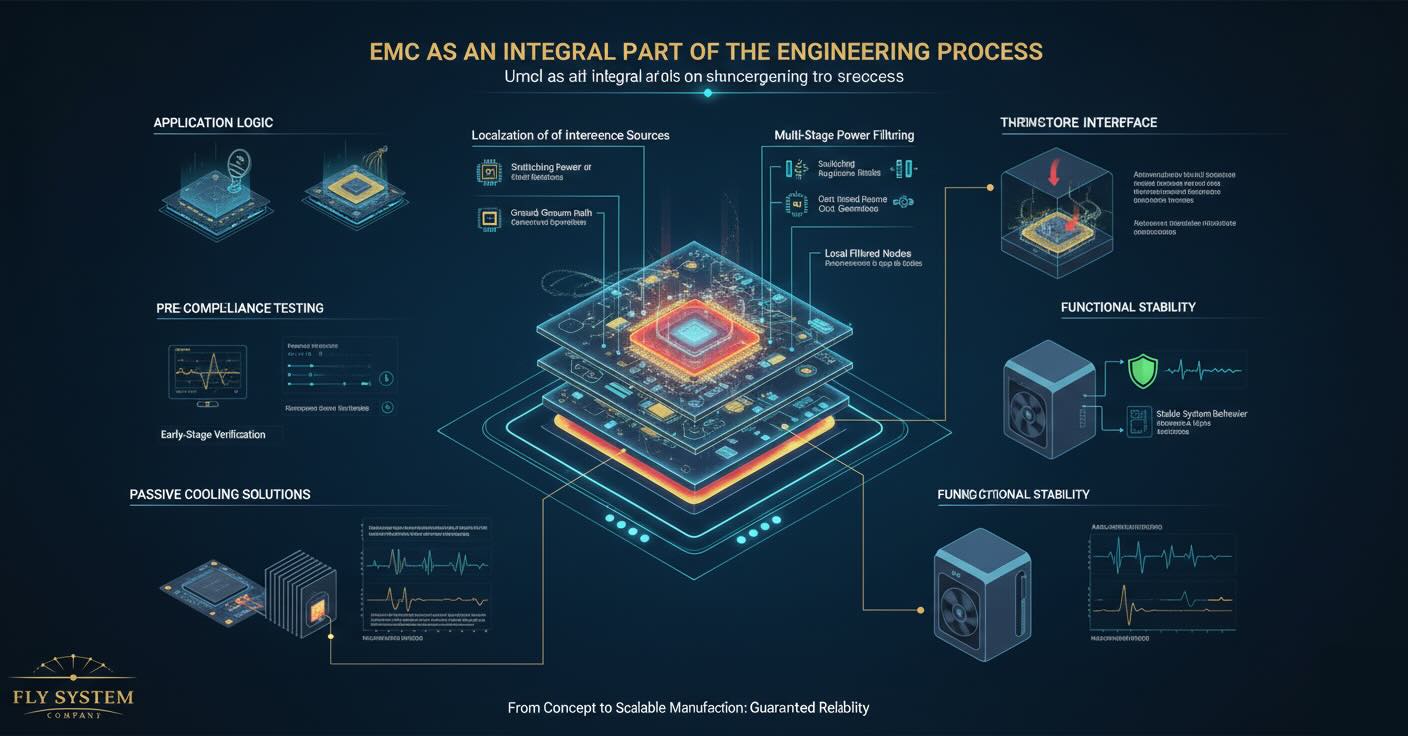
EMC as an Integral Part of the Engineering Process
Electromagnetic Compatibility (EMC) is not a final stage of a project where a device is taken to a lab in the hope that it will “somehow pass.” In complex radio-electronic systems, EMC is a daily engineering task that begins with the very first schematics and architectural decisions.
EMI (Electromagnetic Interference) issues rarely stem from a single cause. Usually, they result from a combination of small decisions: how power is routed, where high-speed lines are placed, how return currents flow through the ground plane, and which switching regulators are positioned near sensitive analog paths. If these factors are not addressed from the outset, no “late-stage filtering” can save the design without major revisions.
The primary focus is the localization of interference sources. Switching regulators, clock generators, and high-speed digital interfaces must not be scattered haphazardly across the board. These components are assigned dedicated zones with controlled current return paths to minimize their impact on RF and analog sections. This not only reduces emissions but also enhances the stability of internal measurements and signal processing algorithms.
Multi-stage power filtering is another area where “cutting corners” quickly leads to significant problems. Filters are implemented not only at the board’s power entry point but also locally near critical nodes, tailored to the frequency characteristics of the interference and load dynamics. This isolates sensitive blocks from switching transients in power circuits and prevents cross-talk between subsystems.
Shielding is used not as a universal “band-aid,” but as a surgical tool where board geometry and component density leave no other options. Shields, metalized enclosures, and local cans are effective only when grounding points are correctly established, ensuring no new ground loops are created that could become radiation sources themselves.
A significant portion of the work involves controlling parasitic emissions at the PCB and enclosure levels. High-frequency harmonics can “leak” through connectors, cable entries, ventilation holes, and even mounting hardware. Therefore, EMC analysis encompasses not just the electrical schematics but also the mechanical design, cable routing, and overall physical layout of the device.
Throughout the development process, we perform pre-compliance checks and measurements well before official certification testing. This allows us to catch issues in the early stages, when changes to routing or layout are manageable and do not necessitate a total PCB redesign. This approach significantly mitigates risks during the certification phase and shortens the time-to-market.
Crucially, EMC is directly linked to the functional stability of the system. Even if a device technically meets regulatory standards, internal interference can degrade reception quality, cause instability in digital interfaces, or trigger elusive, hard-to-reproduce glitches. Thus, we view electromagnetic compatibility not merely as a regulatory requirement, but as a prerequisite for the predictable behavior of the entire system.
Ultimately, this approach results in designs that do not require “heroic” last-minute fixes before mass production. They are consistently reproducible in manufacturing and maintain their performance throughout their entire lifecycle. For our partners, this means fewer technical surprises, predictable project timelines, and significantly lower risks when scaling installations.