
Engineering & R&D: From physical processes to stable infrastructure systems
The company’s engineering developments are centered on creating stable radio-electronic systems for infrastructure environments. These environments combine complex physical conditions, stringent reliability requirements, and the necessity for long-term continuous operation.
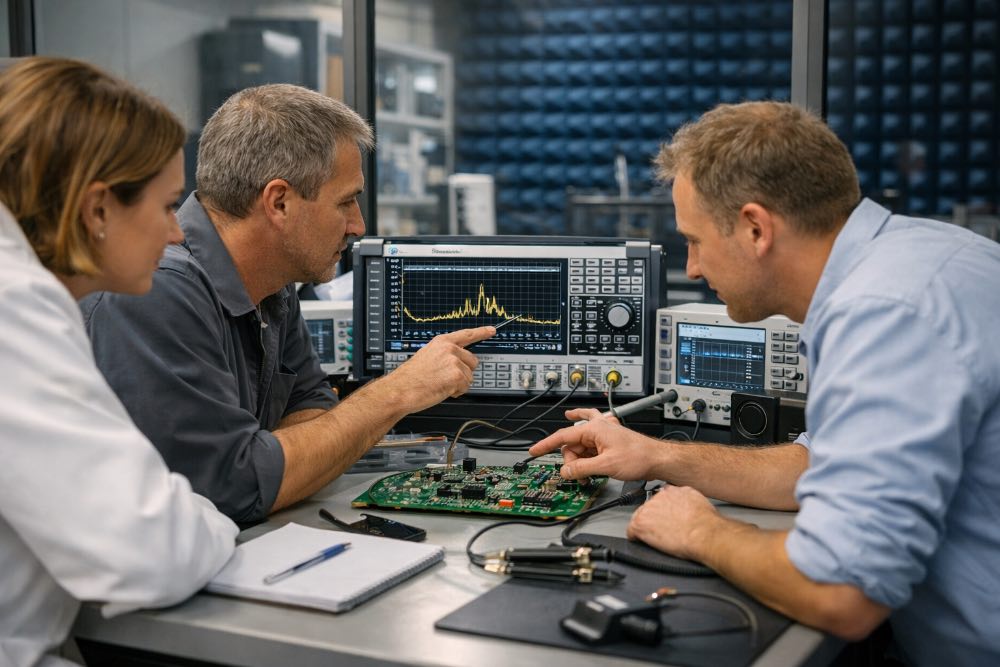
We view R&D not as a discrete stage prior to production, but as a managed engineering cycle. In this cycle, every decision—from physical models to manufacturing documentation—directly impacts the stability of the final product in real-world conditions. We do not design components in isolation; every product is shaped as an integrated system where signal propagation physics, processing algorithms, hardware architecture, and software control infrastructure are synchronized from the earliest stages.
Understanding the operating environment
The design of any system begins with an analysis of its operational context. Infrastructure sites are typically characterized by multipath effects, shielding by metal structures, constantly shifting interference levels, and equipment placement constraints.
Our research includes path loss analysis, the impact of structural elements in buildings and industrial sites, modeling of dynamic scenarios involving moving reflection sources, and statistical assessment of channel stability over time. This data is used not only to tune transmitter parameters but also to define system topology, coverage density, synchronization requirements, and the architecture of distributed nodes.
System-level RF and digital modeling
Based on environmental analysis, we perform system-level modeling of the entire signal path—from the antenna to the application-level data processing. This allows us to evaluate system behavior under various load conditions and identify stability limits before hardware prototypes are even built.
- At the RF level: We analyze local oscillator phase noise, amplifier non-linear distortion, spectral filtering characteristics, and cross-channel interference in multi-channel configurations.
- At the digital level: We model sampling and quantization regimes, digital filtering, time latencies, and data throughput.
This approach enables us to strike an optimal balance between hardware complexity, power consumption, and the required measurement accuracy or communication stability for specific deployment scenarios.
Signal processing and spectral analytics
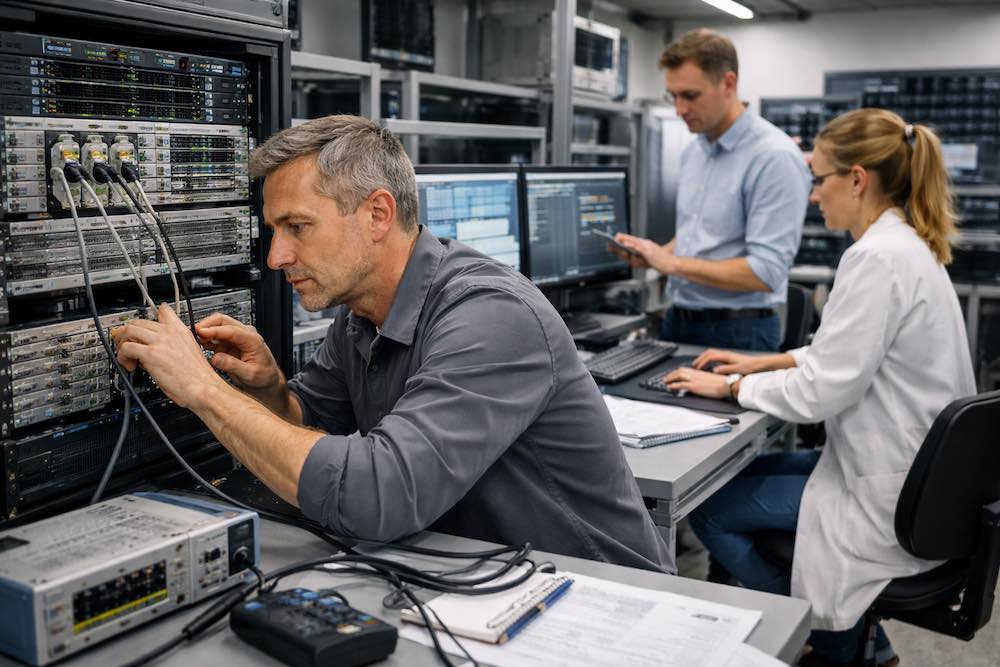
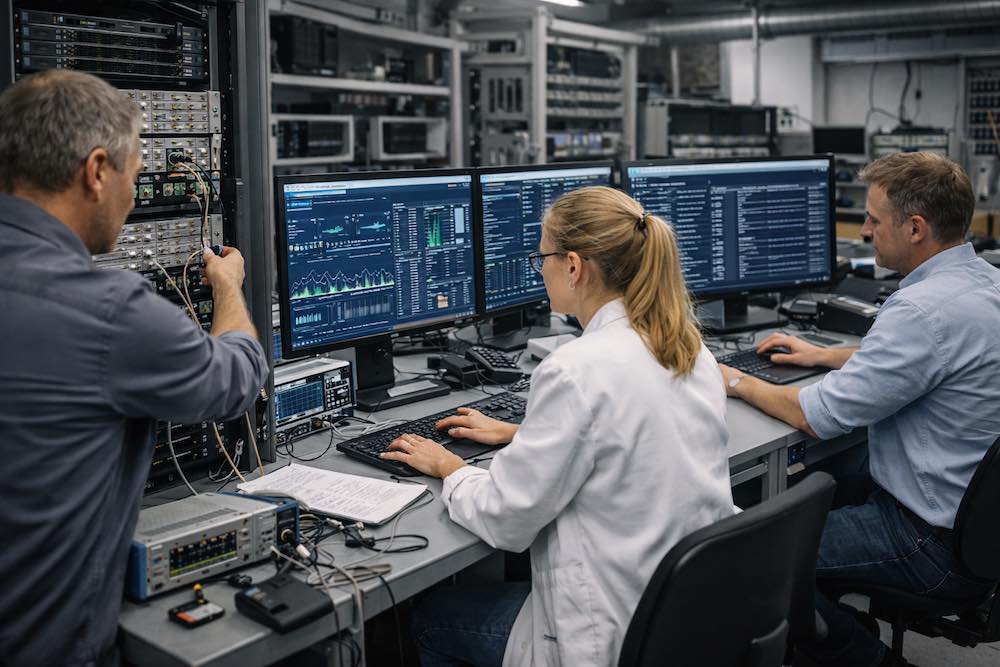
The algorithmic core determines how effectively hardware resources are converted into actionable information within congested spectra and unstable channels. We develop algorithms for high-speed spectral analysis, adaptive interference cancellation, weak signal detection, automatic emission classification, and channel parameter estimation.
A particular emphasis is placed on implementing these algorithms directly on embedded platforms and programmable logic (FPGA). This creates autonomous nodes that do not rely on constant access to external computing resources, thereby increasing resilience to network infrastructure failures and simplifying the scaling of distributed installations.
Embedded software and control logic
Embedded software provides hardware module management, inter-subsystem synchronization, and integration with higher-level digital management platforms. We utilize Real-Time Operating Systems (RTOS) for tasks requiring deterministic latency and stable event response.
The software architecture is modular, separating control functions, signal processing, and communication interfaces. We develop drivers for RF paths, power systems, sensors, and high-speed interfaces, optimized for peak-load performance and automatic failover recovery scenarios. Application-level control implements group device logic, remote updates, and configuration changes without requiring physical access to the equipment.
Hardware architecture and platform design
Hardware architecture is defined by computational performance, interface throughput, and operational stability in harsh electromagnetic environments. We employ a combination of processor systems and programmable logic to distribute tasks between software and hardware domains, optimizing high-speed data paths and minimizing latency.
- Data Bus Design: We design bus structures considering parallel flows, buffering, and scalability without requiring a total platform redesign.
- Integrity & Precision: Particular attention is paid to isolating noise-sensitive zones, multi-layer grounding, and optimized RF trace routing. This reduces parasitic emissions and ensures high repeatability of characteristics in mass production.
- Manufacturing Readiness: Designs are adapted from the outset for automated testing (ATE), ensuring the transition from prototype to series production requires no fundamental design changes.
Power efficiency and thermal stability
For systems operating in continuous load cycles, thermal management directly affects RF characteristic stability and component lifespan. We analyze power consumption profiles across various modes, including peak loads and transients. Thermal flow modeling is performed for enclosures and internal layouts. Power circuits are optimized to distribute heat loss and minimize local hotspots, utilizing both passive and active cooling solutions tailored to specific operational environments.
EMC as part of system architecture
Electromagnetic Compatibility (EMC) is integrated into the development process from day one. It is treated as an architectural element rather than a final checkbox before certification.
- We apply localized interference suppression, multi-stage power filtering, and shielding for sensitive hardware sections.
- Parasitic emissions are controlled at both the PCB and enclosure levels, including the impact of connectors, cable entries, and mechanical components.
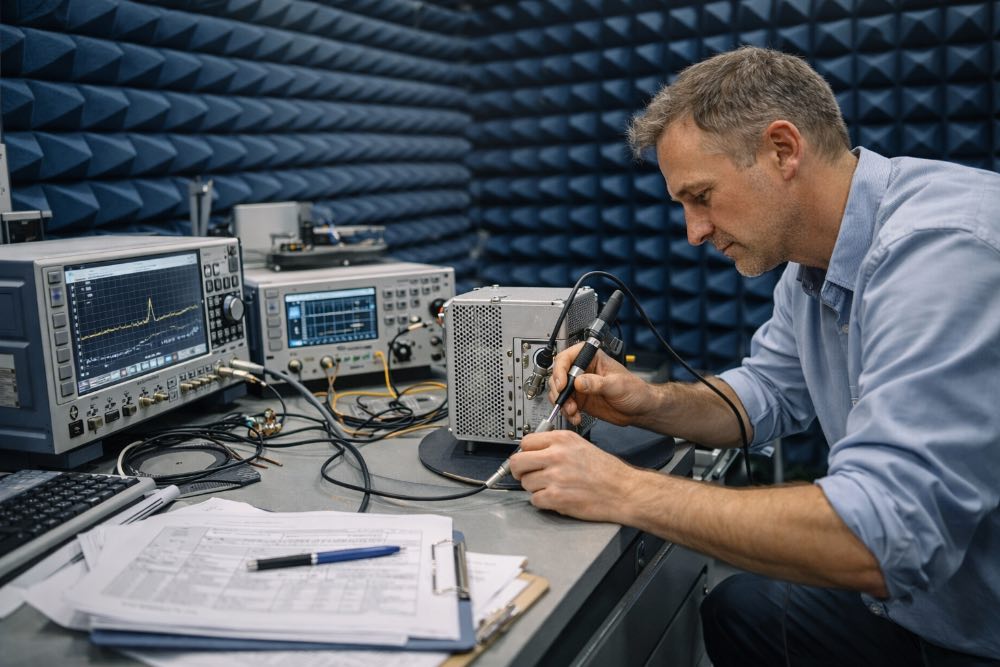
- Pre-compliance EMC measurements allow us to resolve potential issues before official laboratory testing, reducing the risk of late-stage redesigns.
From prototypes to scalable manufacturing
Once technical parameters are stabilized, focus shifts to manufacturing reproducibility. It is vital that the design is not only functional but also technologically stable. We evaluate component supply chain viability, manufacturing process tolerances, and end-of-line (EOL) automated testing and programming capabilities. A comprehensive manufacturing documentation package and quality control procedures are established to move from individual units to a managed serial process without loss of technical performance.
Continuous feedback from real installations
R&D remains an active part of the product lifecycle even after mass production begins. Data from real-world installations is used to analyze system behavior across diverse conditions and to evolve next-generation platforms. This feedback loop allows us to refine algorithms, software modules, and hardware solutions based on actual usage scenarios rather than just laboratory models.
Engineering depth as a basis for long-term systems
The result is a closed-loop engineering cycle where every product serves as a milestone in the evolution of a technological platform, rather than a one-off project. This approach allows us to create systems that remain relevant long after initial deployment, scale without total reconstruction, and evolve alongside the infrastructure they serve. Engineering depth ensures predictable behavior, serial stability, and the viability of long-term infrastructure programs.