Embedded Software and Radio-Electronic System Control
In complex radio-electronic systems, the software layer is what determines whether a collection of boards and modules becomes a managed infrastructure or remains merely a set of disconnected devices. Firmware, real-time logic, drivers, application services, and operator interfaces must function as a single mechanism, synchronized by timing, resources, and usage scenarios.
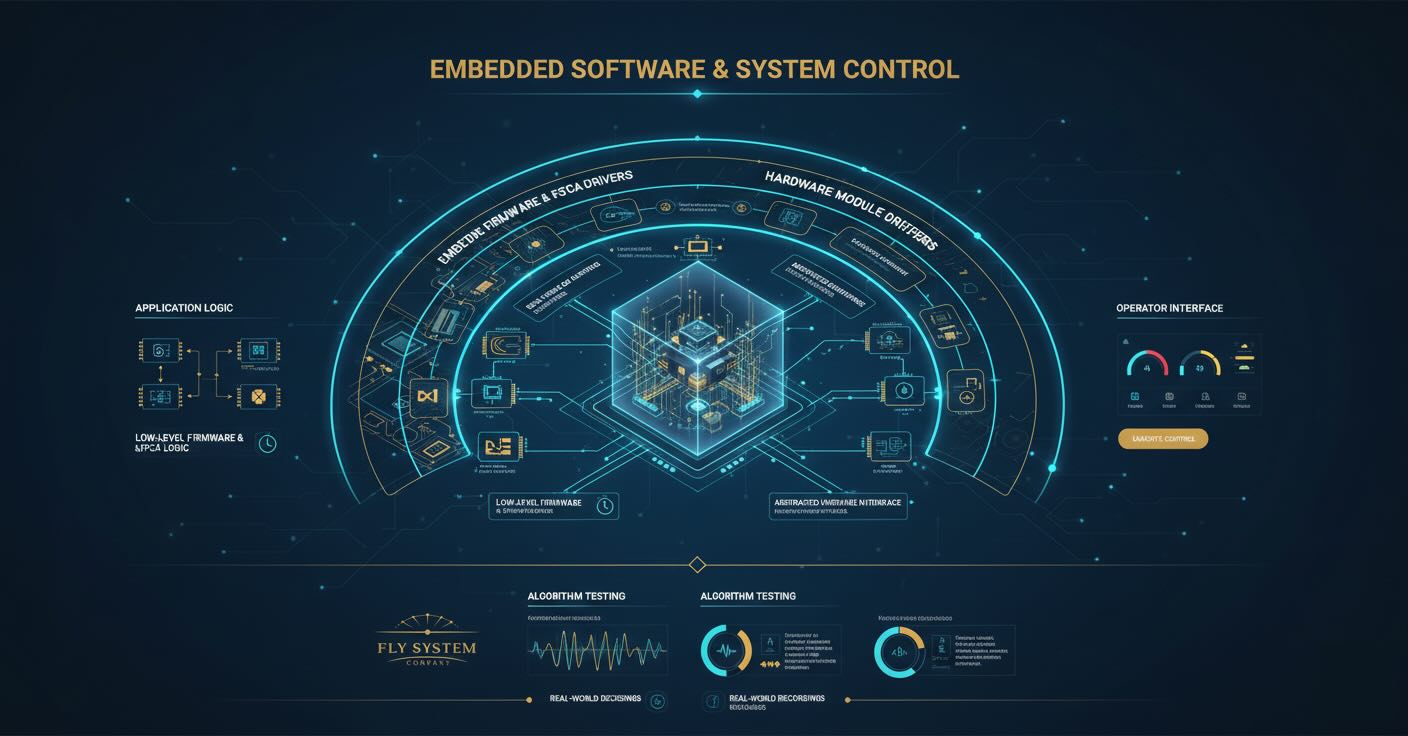
Development begins at the lowest level—with firmware for microcontrollers and FPGA logic. This stage addresses precision timing control, synchronization of high-speed data paths, and lossless data stream processing without unpredictable latencies. By offloading specific signal processing functions directly into hardware logic, we reduce processor load and maintain stable latencies even at high throughput.
Firmware is designed from the outset for a multi-year lifecycle, anticipating updates, modernizations, and component substitutions in series production. Consequently, version control, secure update mechanisms, and failover recovery are not optional features but core architectural components.
Operating above the low-level code is the Real-Time Operating System (RTOS) layer. This layer dictates task prioritization, synchronizes hardware events with software logic, and manages system behavior under resource constraints. Predictability is as vital as speed: signal processing, network exchange, and module control must not interfere with one another, even during peak operational modes. The RTOS layer integrates with self-diagnostic mechanisms, identifying latencies, overloads, or anomalous flow behavior before they impact overall system performance.
Hardware module drivers represent a distinct area of responsibility. They interface with physical components: ADCs, frequency synthesizers, amplifiers, switches, and power systems. Our drivers go beyond simple register access; they account for warm-up periods, propagation delays, and the dependence of parameters on temperature and load. Through these drivers, application layers receive a stable, predictable interface to the hardware, regardless of the specific board revision or component supplier. This abstraction is critical for product line evolution, allowing the hardware platform to advance while the system’s software logic remains stable.
At the application level, the logic of the entire system is formed: how modules initialize, how they coordinate tasks, how the system adapts to changing loads or link conditions, and how non-standard situations are handled.
-
This level implements operational scenarios, automated modes, and functional degradation mechanisms—allowing the system to maintain essential services rather than suffering a total shutdown.
-
A modular approach permits functional expansion without full firmware reflashing or equipment downtime. For infrastructure systems, managed updates are a fundamental requirement to eliminate operational risks.
Operator interaction is a separate, vital layer. Interfaces are designed not as “aesthetic dashboards,” but as tools for rapid decision-making. At any moment, the status must be clear: what is functioning normally, what is in a marginal state, and where intervention is required.
-
Interfaces are tailored to specific user roles, from field operators to service engineers.
-
Critical parameters are prioritized, while detailed diagnostics are accessible without complex menu navigation.
-
We support both local control panels and remote client applications integrated with centralized monitoring platforms.
The entire software stack is developed in close coordination with hardware R&D. This allows for early-stage engineering decisions regarding function allocation: what is best implemented in FPGA logic, what belongs on the processor, and what should be offloaded to the server level. This distribution ensures superior power efficiency, lower latency, and seamless scalability.
Testing extends beyond functional verification to include degradation scenarios: unstable power supply, partial loss of connectivity, channel congestion, and peripheral module errors. The system must not merely “work”—it must be capable of returning to a managed state without manual intervention.
From a business perspective, owning the full software stack provides a critical advantage: complete control over product evolution. New features can be added without hardware replacement, adaptation for specific projects does not lead to fragmented product branches, and system support remains manageable throughout the entire lifecycle. For partners, this means receiving a platform that evolves alongside their infrastructure, avoiding technological dead-ends and the need for a total system overhaul after only a few years of operation.