Power Efficiency and Thermal Control
In continuously operating infrastructure systems, heat is not merely a side effect; it is a primary factor determining equipment stability and lifespan. Even if electronics technically remain within rated temperature limits, constant thermal cycling, localized hotspots, and uneven loads eventually degrade the accuracy, reliability, and repeatability of performance characteristics.
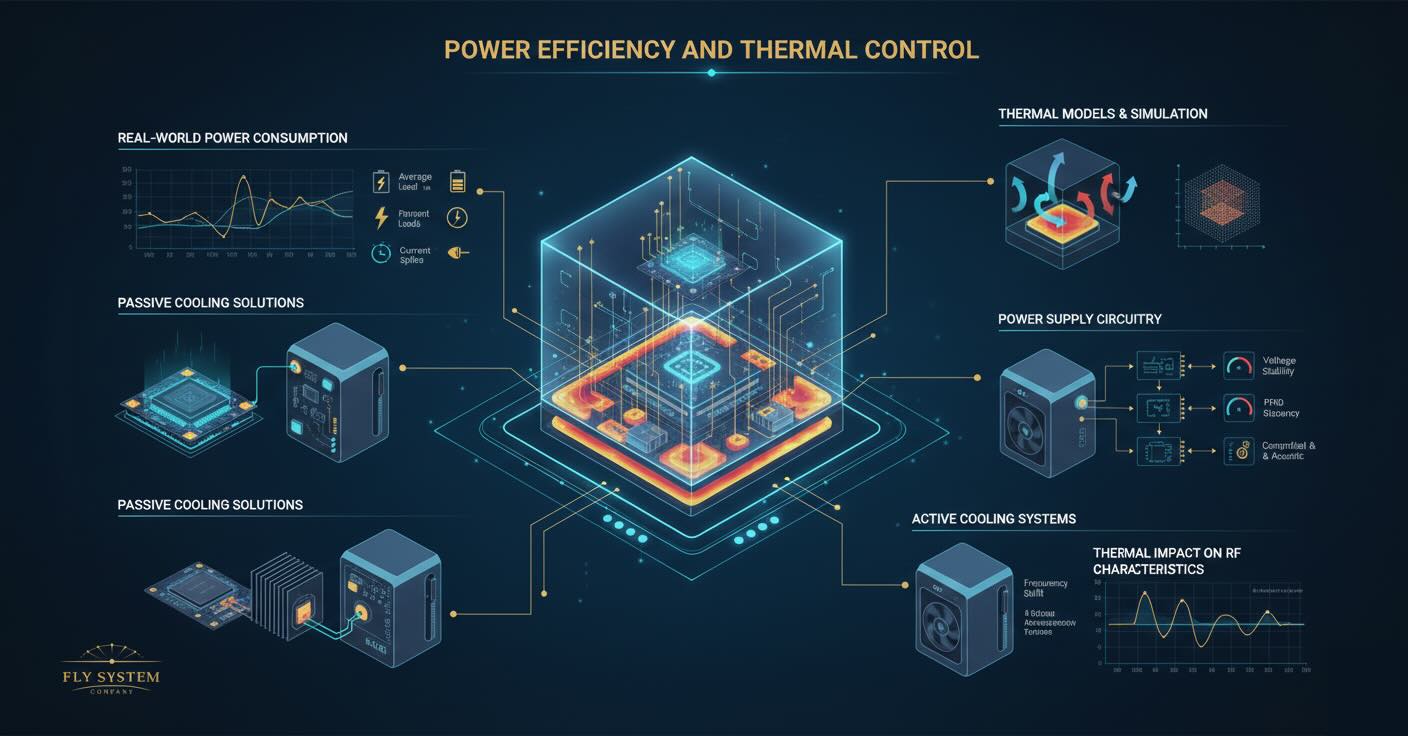
Our approach to power efficiency begins not with heat sinks, but with an analysis of real-world power consumption. We examine more than just average values, focusing on peak loads, transients, startup phases, and load fluctuations across various operational scenarios. Frequently, short but regular current spikes create thermal issues that remain invisible in static calculations.
Based on these profiles, we build thermal models for enclosures and internal layouts. We analyze internal heat dissipation, identify localized hotspots, and simulate system behavior under varying ambient temperatures and ventilation conditions. This allows us to make informed decisions regarding component placement, thermal interfaces, enclosure materials, and heat dissipation strategies well before serial production begins.
Power supply circuitry plays a key role. Optimization in this area involves more than just converter efficiency; it focuses on voltage stability under dynamic loads, the distribution of thermal losses among components, and the minimization of local hotspots. A well-engineered power system reduces overall heat dissipation while simultaneously enhancing the stability of sensitive analog and RF circuits.
When selecting cooling solutions, we prioritize passive methods—thermal paths, heat sinks, interface materials, and utilizing the enclosure itself as a heat dissipation element. Passive cooling is valued for its simplicity, lack of moving parts, and superior reliability during long-term operation.
Active cooling systems are implemented only when necessitated by component density or environmental conditions. Even then, the decision is not a matter of simply “adding a fan.” We account for airflow patterns, acoustic requirements, dust ingress, and maintenance needs. In many cases, maintaining a stable temperature without sharp fluctuations is more critical than achieving maximum cooling performance.
We pay specific attention to the thermal impact on RF characteristics. Frequency shifts, gain fluctuations, and filter parameter drift may seem negligible at the component level, but they accumulate within the system, impacting overall signal quality and the stability of processing algorithms. Therefore, thermal regimes are managed as an integral part of the RF path’s stability, not just as a matter of component longevity.
The goal of this comprehensive effort is to ensure the system can operate through long-term cycles without performance degradation or the need for frequent intervention by service teams. Controlled thermal and power regimes result in fewer failures, simplified maintenance, and the ability to achieve high-density equipment layouts without compromising stability.
From a practical standpoint, this translates to lower operational costs, extended equipment life, and predictable behavior across diverse installation environments—from dedicated technical rooms to confined spaces. For partners and operators, this provides the assurance that the solution will remain stable not just at launch, but throughout its entire lifecycle.