Production & Certification: From engineering design to scalable and compliant manufacturing
For infrastructure systems, a working prototype is not yet a finished product. Between a laboratory sample and a serial product lies a stage where engineering solutions must be translated into reproducible manufacturing processes and validated against the regulatory requirements of various markets.
Preparation for mass production and certification is treated as a dedicated engineering discipline integrated into the overall development cycle. This prevents situations where a technically successful product proves difficult or risky to scale.
Manufacturing readiness as part of system design
Manufacturing readiness is embedded as early as the architectural design phase. The design of hardware modules, component selection, and PCB topology are shaped by technological tolerances, component availability, and automated assembly capabilities.
We employ Design for Manufacturing (DfM) and Design for Test (DfT) principles to ensure consistent quality in serial batches and to simplify functional verification for every unit on the production line. Test points, primary programming interfaces, and functional validation procedures are integrated into the design, allowing for the detection of deviations before the equipment is shipped to the customer. This approach minimizes discrepancies between prototypes and serial units, ensuring the repeatability of key technical parameters in large-scale production.
Technical documentation and production transfer
Preparation for manufacturing includes the creation of a comprehensive technical documentation package required by contract manufacturers and for ongoing product support. This documentation covers schematics, Bills of Materials (BOM), assembly drawings, testing procedures, software configurations, and service manuals. All materials are coordinated with production partners and adapted to specific technological processes.
The transfer to production is accompanied by the collaborative setup of test benches, line programming, and process stability verification through pilot batches. This enables the early identification of manufacturing risks and allows for adjustments before full-scale production begins.
Pre-compliance testing and laboratory validation
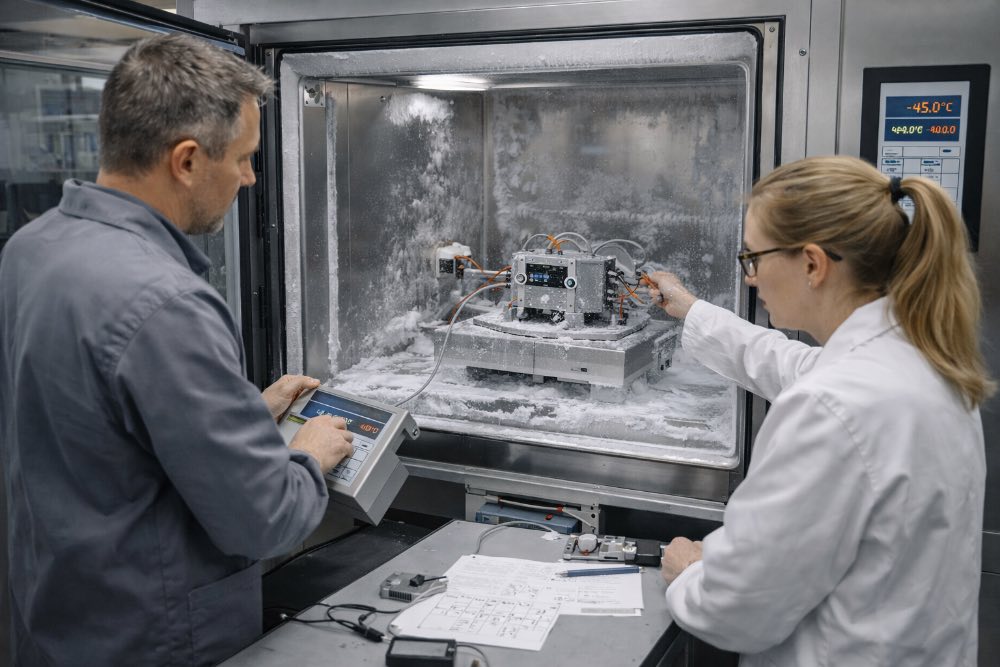
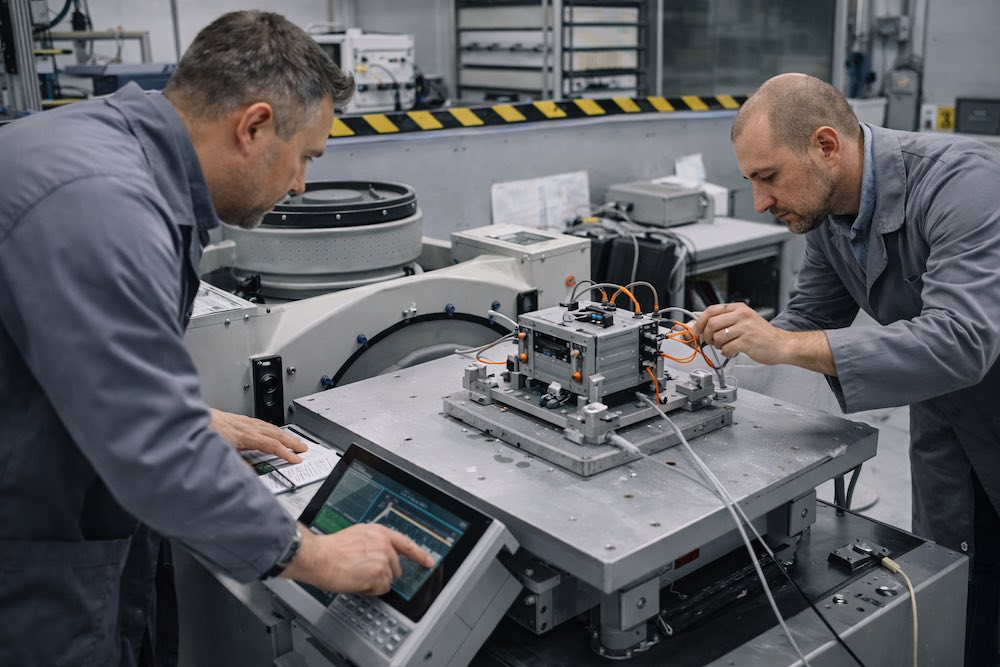
To mitigate risks during formal certification procedures, pre-compliance checks are performed throughout the development process. We conduct measurements of electromagnetic emissions, immunity to interference, power stability, and thermal regimes under typical operational scenarios.
The results of these checks are used to refine both hardware and software before official laboratory trials begin, significantly reducing the likelihood of a total redesign at the final stages. Pre-compliance testing also allows us to align configurations with accredited laboratories, ensuring that formal tests accurately reflect the system’s real-world operational modes.
Certification support for civil markets
Our support for certification procedures includes the preparation of technical dossiers, coordination with accredited laboratories, and active participation in the testing process. Test plans are formulated based on the regulatory requirements of specific markets and the actual operating conditions of the equipment. This ensures that checks are not merely formal exercises but a confirmation of stable system performance in typical application scenarios.
Should any issues arise during testing, our engineering teams promptly implement design or software changes while maintaining readiness for mass production. This approach prevents market entry delays and ensures compliance in scalable production, rather than just in isolated samples.
Scaling production and supply chain stability
Scaling production requires not only increased volume but also supply chain stability and quality management. Component selection and the identification of alternative suppliers are performed with a focus on long-term availability and the ability to substitute parts without significantly impacting technical characteristics.
We conduct risk analysis related to changes in the component base and, if necessary, prepare backup platform configurations to ensure production continuity amidst supply chain fluctuations. Quality control on the production line combines automated testing with periodic in-depth inspections, balancing throughput with parameter stability.
Manufacturing as part of long-term product strategy
Preparation for production and certification is not viewed as a one-off project for a single product. It is part of a long-term product strategy where technological platforms evolve incrementally without a total overhaul of manufacturing processes.
This allows for the introduction of new features, modernization of hardware modules, and software updates while maintaining compatibility with existing production lines and testing procedures. The result is a managed transition from engineering prototypes to stable serial manufacturing that supports both current projects and the development of new products based on proven technological solutions.